Global Pulse · Europe · Local production
XPeng and Magna in advanced talks on a Slovenian plant, media say
Reported
Slovenian media report that XPeng and Magna are in advanced talks to build up to 100,000 cars a year at Magna’s plant in Hoče, Slovenia. An agreement could come before the end of 2026. Magna’s chief executive and XPeng co-president Brian Gu have toured the site, the daily Večer reports, and Slovenia’s government says it knows of Magna’s talks.
What the reports say
On 5 November, Slovenian TV news service 24ur reported advanced talks between Magna and XPeng to build cars at Magna’s plant in Hoče, Slovenia.
Zdravko Počivalšek, a state secretary in Slovenia’s prime minister’s office, told 24ur that the government knew about Magna’s talks with its partners. He said the government supported building complete cars in Slovenia. 24ur identified XPeng through its own reporting. Počivalšek was economy minister when he brought Magna to Slovenia in 2017.
24ur put the cost at €500–600 million. The plant could build up to 100,000 cars a year and create at least 1,000 jobs. 24ur says Magna’s production lines in Austria are fully booked, and its sources see the plant in Slovenia as very likely to get the work. The first cars could be built in 2029, the outlet reported.
Marko Soršak, the local mayor, said his municipality works with the government every week to prepare for the project. He declined to discuss figures.
On 4 November, Austria’s Kleine Zeitung cited industry sources who spoke of a possible joint venture between XPeng and Magna. They put production at 100,000 cars a year and said assembly could start in late 2028 or early 2029.
The Slovenian daily Večer was the first to name XPeng, on 17 October. It reported that Magna chief executive Swamy Kotagiri and XPeng honorary vice-chairman and co-president Brian Gu had toured the site together. Večer said the companies also talked at the Paris Motor Show. In a separate piece, it reported that talks also cover a wider network of suppliers on both sides of the border.
Magna told both papers it would not comment on speculation. Slovenia’s economy ministry said its talks with investors were confidential. It said it would announce any state aid the government approves.
Why XPeng wants to build more cars in Europe
In September, 5,274 new XPeng cars were registered across 30 European countries, about three times as many as a year earlier, according to XPulse’s count.
Magna already builds four XPeng models in Graz: the G6, the G9, the P7+ and the new G9L flagship.
At the Paris Motor Show on 12 October, XPeng chief executive He Xiaopeng said XPeng and Magna were discussing more output in Graz. He said XPeng was also speaking with several countries and companies about where else it could build cars or expand production. Bloomberg reported that He pointed to Volkswagen’s investments in China as an example of how XPeng wants to build cars locally in Europe.
XPeng vice-president Yeqing Zheng told Reuters that Graz could no longer build enough cars to meet XPeng’s needs. He expects growth in Europe to stay in the “high double digits”. XPeng would work with a local manufacturer on a second production line, either at a new plant or an existing one. The line would build “mid-level” cars at a lower cost than Graz. Zheng expects it to be running by the time the EU’s proposed “made in Europe” rules take effect.
Not every existing plant would do. In May, Elvis Cheng, XPeng’s general manager for north-eastern Europe, told the Financial Times that XPeng was talking to Volkswagen about a site in Europe. He said not all factories meet the needs of XPeng’s newest cars, and that some of Volkswagen’s plants were “a little bit old”.
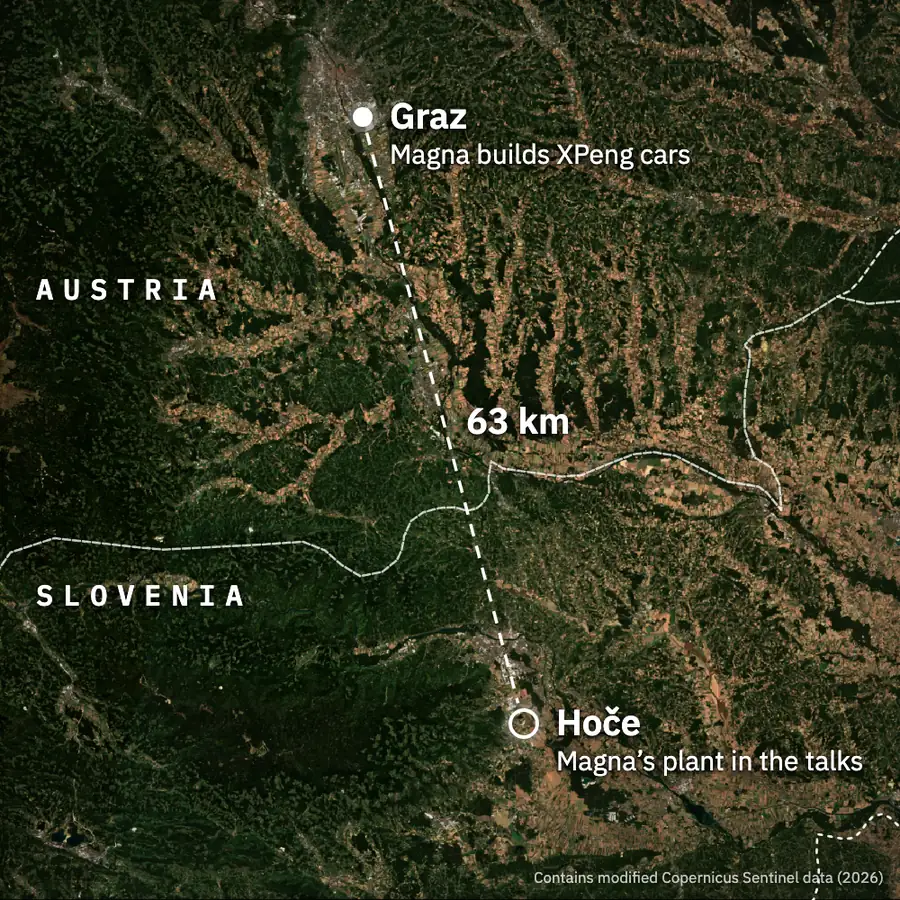
Under the reported plan, Magna would weld, paint and assemble whole cars at the Slovenian plant. In Graz, it assembles XPeng cars from part-built kits shipped from China.
XPulse’s reading: the Slovenian plant fits what Zheng described. Magna already owns the site, it is close to Graz, and it has an initial environmental approval for full car production. Its paint shop opened in 2019, and the body shop and assembly hall would be new. The MONA L03, XPeng’s lowest-priced SUV in Europe, is shipped to Europe from China. It is the kind of “mid-level” car such a line could build.
Europe’s “made in Europe” plan
The European Commission proposed the rules in March 2026. Under them, electric cars would need enough European-made parts and battery content to get public support, such as purchase grants and company-car tax breaks.
That is why a local supply chain matters. XPeng is building one in Europe, and Zheng told Reuters that finding a battery supplier there that meets XPeng’s needs will be “challenging”.
The proposal also sets conditions for investments of more than €100 million in electric-car plants. They would apply to companies from a country that holds more than 40% of the world’s manufacturing capacity in that sector, as China does. The conditions on the list include foreign ownership below 49% and at least half of the workers from the EU. The European Parliament and EU governments are still working on the proposal.
Import duties are another reason Chinese carmakers want to build complete cars in Europe, Večer writes. XPeng pays an extra 20.7% on electric cars made in China, on top of the usual 10% import duty. Slovenia voted against the extra duties in 2024.
A car plant that stopped at the paint shop
Magna planned to build complete cars at its Slovenian site from the start. In December 2016, Slovenia’s parliament passed a special law to secure 87 hectares of farmland for the project. It was expected to create at least 1,000 jobs. Magna said in January 2017 that it would start with a paint shop. Don Walker, its chief executive at the time, said Magna would wait until it had enough work before investing in a full assembly plant.
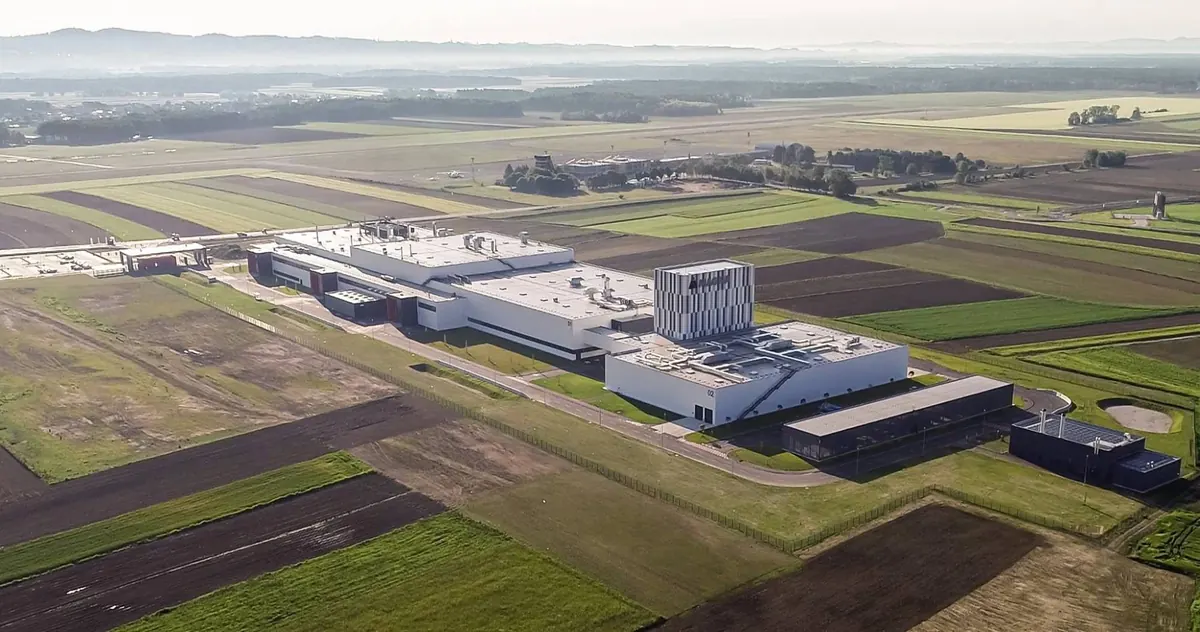
The paint shop opened in July 2019. It cost €146.4 million, including €18.6 million in state aid. It employed just over 200 people and painted car bodies for Magna’s Graz plant, starting with the Jaguar E-Pace. Magna later applied to add a body shop and an assembly hall. It received the initial environmental approval in late 2021.
The orders needed to start full production never came. Work stopped several times during the pandemic and the parts shortages that followed. In March 2023, Magna moved the painting work back to Graz. By June, it had repaid €22.1 million in state aid and interest.
A smaller team stayed to build prototypes for BMW. When that work ended in August 2025, 30 more jobs went. About 30 people still work there, Večer reports. Other Chinese carmakers have been linked to the site before, Nio among them in 2025.
Permits, farmland and a signed deal
The initial environmental approval lets Magna apply for the remaining permits, Večer reports. It still needs a building permit, a separate environmental permit and, finally, permission to use the plant.
The project used good farmland that has to be replaced. More than 100 people own the land set aside to replace it, and about one in five has agreed so far. Any state aid would need the government’s approval.
For the plant in Slovenia, the next big step would be a signed agreement between Magna and XPeng. Both 24ur and Večer say that could happen by the end of 2026. Zheng said XPeng expects to decide on its second European production line within months.
Topics
Where this comes from
- MediaInvestment of up to €600 million: Chinese cars could be built in HočeSL · 24ur (POP TV news) · 5 Nov 2026
- MediaForeign investment: will Magna and Xpeng join forces in Hoče?SL · Večer · 17 Oct 2026
- MediaMagna on the verge of large orders from ChinaDE · trend / APA · 4 Nov 2026
- MediaXpeng executive says EV maker will expand European production ahead of local content rulesReuters · 12 Oct 2026
- MediaMagna (MGA) Q3 2026 Earnings Call TranscriptMagna results call · 30 Oct 2026
- XPulseXPeng assembly at Magna’s Graz plant12 Oct 2026
- XPulseXPeng registrations in Europe7 Nov 2026