Investor Pulse · Guidance
XPeng’s 2030 Europe goal is four times all its exports today
Reported
XPeng wants to sell a million cars a year by 2030, half of them in Europe, He Xiaopeng told Bloomberg in Paris. Its exports have doubled this year and reached a record pace in September, about 120,000 cars a year. It is weighing a second European production line and is offering its technology to other carmakers.
A million cars a year, half of them in Europe
He Xiaopeng, XPeng’s chairman and chief executive, gave the figure in an interview with Bloomberg at the Paris Motor Show on 12 October. XPeng aims to sell one million cars a year, with Europe accounting for half. Bloomberg puts the European part at 500,000 cars a year by the end of the decade.
The starting point is the strongest XPeng has had abroad. Its exports in the first nine months of 2026 were twice those of a year earlier, and the registrations XPulse counts in Europe have already passed the whole of 2025. In September it exported 10,055 cars and kits, the most in any month on XPulse’s record. A year at that pace is about 120,000 cars, for every market outside China together, so the goal for Europe alone is about four times that. Bloomberg notes that 500,000 a year in Europe would be more than Ford (over 426,000) or Opel (about 400,000) sold there last year.
| Cars a year | |
|---|---|
| Exports nowSeptember’s 10,055 × 12 | 120,660 |
| Europe by 2030the goal, for Europe alone | 500,000 |
XPulse arithmetic. Exports are cars and kits for every market outside China, on the count of CPCA, China’s passenger-car association; September 2026 is the latest month.
The million has been stated in two ways. Bloomberg reports it as sales worldwide. He’s letter to staff in February set one million a year outside China by 2030, with more than 70% of profit from abroad, and he said “outside China” again to a German magazine in July. Alex Tang, who heads XPeng’s international business, put it the same way at a media session in Paris on 11 October and said Europe is about half of overseas sales, according to a Chinese car blogger who attended. XPulse’s reading: Europe’s figure is 500,000 cars a year either way. XPeng’s Paris release does not state the 2030 figure, so whether sales in China come on top of the million is not disclosed yet.
XPeng wants to build more in Europe
He Xiaopeng told Bloomberg that production capacity is XPeng’s most critical bottleneck in Europe. Today Magna, a contract manufacturer, assembles three XPeng models in Graz, Austria: the G6, the G9 and the P7+. The new G9L has passed its first production trial there. The MONA L03, XPeng’s lowest-priced SUV in Europe, is built in China.
At a round table with media on 12 October, He said XPeng is discussing with Magna how to raise output at Graz, reports EV, a news site that took part. It is also talking to several countries and companies about new or expanded capacity, he said. Bloomberg reports that he pointed to Volkswagen’s investments in China as the model: XPeng wants to build in Europe rather than rely on imports.
Yeqing Zheng, an XPeng vice-president, gave Reuters more detail. Graz can no longer keep up, he said: its volume “is not even sufficient” as XPeng expects to keep growing by “high double digits” in Europe. A second production line would be run with a local manufacturer, in a new plant or an existing one. It would build “mid-level” cars at a lower cost than Graz. A decision will come within months, and the line should be running by the time the EU’s new “made in Europe” rules take effect. Those rules set a minimum share of local content for electric cars.
On stage the evening before, He went further than cars. In future, he said, XPeng will also make powertrains, chassis and core components in Europe.
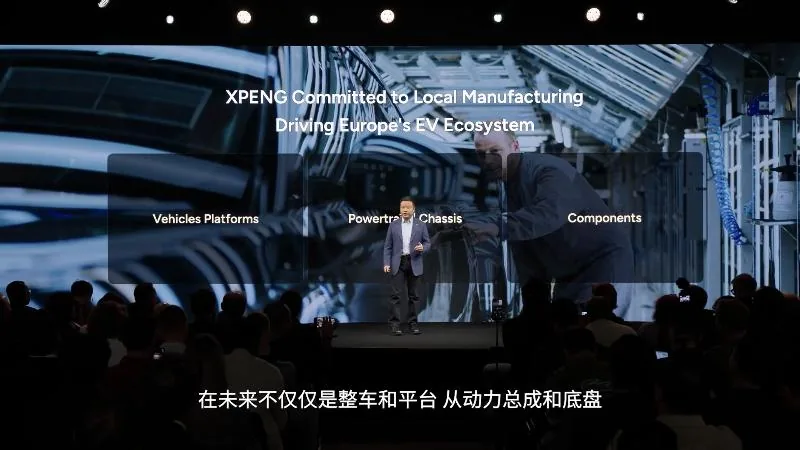
XPeng is also building up a local supply chain, Zheng said. Finding a battery supplier that meets its needs for fast charging and energy density will be “challenging”, he added. The country, the partner and the size of the second line are to come with the decision.
XPeng offers its technology to other carmakers
At its press conference XPeng launched XPENG AI Engineering, which opens its own electric-car technology to other carmakers around the world. Its release says this is the first time it offers that technology outside China. Until now Volkswagen has been the one carmaker named as a customer, for cars it sells in China.
A Chinese technology outlet that sat in on XPeng’s technical session in Paris describes three levels. XPeng can adapt its systems to a partner’s existing model, develop a new body on one of its own platforms, or develop a whole car. Engineers from both sides work in joint teams, as with Volkswagen. Beyond cars, XPeng says its Robotaxi, its Turing AI chips and its AI models are open to partners too.
One agreement was reported at the show: Chinese media carrying XPeng’s Chinese release say it signed a strategic framework agreement with the tyre maker Michelin. He had said on 17 September that several new cooperation cases might be announced at the show. No carmaker customer beyond Volkswagen has been disclosed yet; a first one would be the clearest proof that the offer works.
Why this matters to the accounts: Volkswagen’s fees are booked in XPeng’s “services and others” revenue. In the second quarter of 2026 that line was 14% of revenue and about half of gross profit, on XPulse’s arithmetic from XPeng’s results.
Driver assistance: on Paris streets, ahead of approval
XPeng is giving the public rides in Paris with NGP, its advanced driver assistance, which the driver must supervise. At the show’s official test area, only XPeng and Tesla offer such rides. NGP runs on VLA 2.0, XPeng’s AI driving model.
For European customers it comes with approval under the UN’s rules for driver-assistance systems, whose updated version the EU makes mandatory from January 2027, He’s slide said. He hopes XPeng will be among the first carmakers certified. XPeng’s English release goes further and says it aims to be the first. His standing target for European approval is the first half of 2027.
Liu Xianming, who leads the team behind the driving model, told Bloomberg that adapting it from one European country to the next takes about two weeks. It needs about one ten-thousandth of the data used to train the model, he said. XPeng wants to bring the full system to Europe, not a reduced one.
Robots and Robotaxis: the first European plans
XPeng gave its IRON humanoid robot a European date, the first on XPulse’s record. He’s slide showed three steps: mass production in late 2026, first deliveries in the first half of 2027, and Europe in the second half of 2027. The first robots are to work in shops and shopping centres.
Two other statements sit close to it. Co-president Brian Gu told the Singapore broadcaster CNA on 9 October that IRON would be offered to outside customers from the second half of 2027, and XPeng’s Paris release says “global rollout in 2027”.
On Robotaxis, XPeng says it is in talks with leading European ride-hailing platforms. Gu told CNA that XPeng hopes to start pilot tests in selected cities abroad next year. CNA puts the pilot fleet in Guangzhou, where the service opened to invited riders on 8 October, at close to 100 cars.
The cars: G9L on sale, L05 next
The show’s product news was the G9L, XPeng’s new flagship SUV, with six or seven seats in Europe. Orders opened in nine European countries on 12 October, from €74,990 in France. The first cars reach customers in December, XPeng’s German release says. Europe’s G9Ls are built in Graz.
The L03 has taken 12,136 orders in Europe in under three months, He said, before test cars reached the stores. Its larger sibling, the MONA L05, follows in Europe in early 2027. Tang said XPeng will have more than 1,000 stores outside China next year, the same blogger reports. XPeng now counts 1,283 stores worldwide, in 82 countries and regions.
New in Paris, and already on file
Much of what was said in Paris builds on earlier plans. The table sets the main points beside what XPeng had said before.
| Subject | Said in Paris | On file before |
|---|---|---|
| 2030 sales | 1 million a year, half in Europe | 1 million a year outside China |
| Factories | A second line, decided in months | Three models built in Graz |
| Technology offer | Open to carmakers worldwide | Volkswagen, in China |
| Driver assistance | To be among the first certified | European approval by mid-2027 |
| IRON robot | Europe in the second half of 2027 | Deliveries from 2027 |
| Robotaxi abroad | Talks with European platforms | A hope to bring fleets to Europe |
| MONA L05 | Europe in early 2027 | China launch in late 2026 |
| Fast charging | 4,000+ points in Europe by 2028 | The same plan |
“On file before”: XPeng’s earlier statements as XPulse recorded them, on the Management Tracker and in Technology.
He on the share price: “not worried at all”
XPeng’s New York shares closed at $9.66 on 12 October. They have been below $10 since late September, for the first time in two years. Asked at the round table what investors were missing, He said the boom in AI investment had drawn money away from carmakers, and that he was “not worried at all”, EV reports. He called it a matter of two or three years. Until then, XPeng should get its fundamentals, its cash flow and its research organisation right, he said.
He also said XPeng is adding about 8,000 staff a year and raising research spending by close to 40% a year. The results on file bear the second figure out: research and development cost RMB5.82bn in the first half of 2026, 39% more than a year earlier.
What to watch next
Three things would turn the plan into fact, and each can be followed in the coming months. The first is the decision on a second European production line, with a partner and a country. The second is a first customer for XPENG AI Engineering beyond Volkswagen. The third is European approval for its driver assistance, which XPeng targets for the first half of 2027. XPeng’s third-quarter results are expected in November.
The nearer measure is this year’s, and abroad it is moving the right way. XPeng delivered 284,367 cars worldwide in January to September. Of those, 59,479 were exports, on the passenger-car association’s count: twice the figure a year earlier and 20.9% of deliveries. He expects overseas sales to pass 40,000 in the fourth quarter. In Europe, XPulse counts about 34,600 XPeng registrations in the first nine months of 2026, already more than in all of 2025.
- The Paris Motor Show, update by update →
- Management’s targets, dated and sourced →
- XPeng’s plant guide for Graz →
Where this comes from
- Primary XPENG Launches the G9L Next-Gen AI Flagship SUV in Europe, Debuts NGP and Expands Global Technology Collaboration at 2026 Paris Motor Show · XPeng (release on PR Newswire) · 2026-10-12
- Primary XPENG Paris Night and Paris Motor Show press conference, as broadcast with Chinese subtitles (replay) · XPeng (Weibo live room) · 2026-10-12
- Primary “In Europe, For Europe, With Europe.” 小鹏正式发布全新欧洲战略 (XPENG AI ENGINEERING; Robotaxi talks with European platforms) · XPeng (official Weibo) · 2026-10-12 · ZH-CN
- Primary 小鹏已在全球设有 8 大研发中心和 6 大生产基地 (82 countries and regions; charging network; research spending) · XPeng (official Weibo) · 2026-10-12 · ZH-CN
- Primary One Infra, Two Products (Robotaxi XPENG YOYO; IRON mass production at the end of 2026, deliveries from the first half of 2027) · XPeng (official Weibo) · 2026-10-12 · ZH-CN
- Primary 2026 年上半年,小鹏在法国的销量位居中国新势力品牌第一 (MONA L03 orders in Europe) · XPeng (official Weibo) · 2026-10-12 · ZH-CN
- Primary Europapremiere und Marktstart auf dem Pariser Automobilsalon: Neuer XPENG G9L ab sofort zu Preisen ab 74.600 Euro bestellbar · XPeng (European newsroom) · 2026-10-12 · DE
- Media China’s Xpeng Seeks to Edge Past Ford, Opel in Europe by 2030 · Bloomberg · 2026-10-12
- Media Xpeng targets 1 million annual global sales by 2030, half from Europe · CnEVPost, reporting Bloomberg’s interview · 2026-10-13
- Media Xpeng executive says EV maker will expand European production ahead of local content rules · Reuters (as carried by Euronext) · 2026-10-12
- Media XPeng CEO Says He Is ‘Not Worried at All’ as Stock Hits 2-Year Low · EV (eletric-vehicles.com), at the round table · 2026-10-12
- Media XPeng Sets Second-Half 2027 European Rollout for IRON Humanoid Robot · EV (eletric-vehicles.com), at Paris Night · 2026-10-11
- Media XPeng Says L03 SUV Has Drawn Over 12,000 Orders in Europe Since July Launch · EV (eletric-vehicles.com), at Paris Night · 2026-10-11
- Media Xpeng Says It Can Quickly Adapt Car Autopilot Systems for Europe · Bloomberg · 2026-10-11
- Media 小鹏智驾出海欧洲:两周微调适配一个国家,计划 2027 年落地 NGP · IT之家, reporting Bloomberg’s interview with Liu Xianming · 2026-10-12 · ZH-CN
- Media XPeng L03 tops 12K orders in Europe, opens tech partnerships to global automakers · ChinaEV Home, at Paris Night · 2026-10-12
- Media 不只是卖车:小鹏在巴黎展示中国汽车技术出海的新路径 · 热点科技 (via Sohu), at XPeng’s technical session · 2026-10-12 · ZH-CN
- Media 小鹏G9L巴黎车展全球上市 (XPeng’s Chinese release, as carried) · 极目新闻 (via 21st Century Business Herald) · 2026-10-13 · ZH-CN
- Community 小鹏海外战略:不止卖车,更想成为欧洲研发供应链的一部分 (Alex Tang’s session in Paris) · 万万_ECC, car blogger (Weibo) · 2026-10-11 · ZH-CN
- Media Xpeng to test robotaxis overseas from next year, says vice-chairman and president Brian Gu · CNA · 2026-10-09
- Media 何小鹏新年放狠话:今年再招八千人,2030年海外冲击百万销量 · 车东西 (via Sina Finance), on He Xiaopeng’s staff letter · 2026-02-24 · ZH-CN
- Media Interview with Xpeng CEO He Xiaopeng: “We don’t just want to make money” · VISION mobility · 2026-07-27
- Media 预计2026巴黎车展披露最新案例!小鹏正与更多车企洽谈技术合作 · National Business Daily (via 163) · 2026-09-18 · ZH-CN
- Primary XPeng’s monthly deliveries and exports · XPulse delivery record (XPeng releases; CPCA) · 2026-10-13
- Primary XPeng registrations by market · XPulse registrations record (national registries) · 2026-10-13
- Primary XPeng quarterly results · XPulse financial record (XPeng results releases) · 2026-10-13
- Primary Latest registrations, September 2026 · XPulse registrations record (national registries) · 2026-10-13