China Pulse · Product
Gu Jie says IRON’s solid-state batteries enter small-batch production
Reported
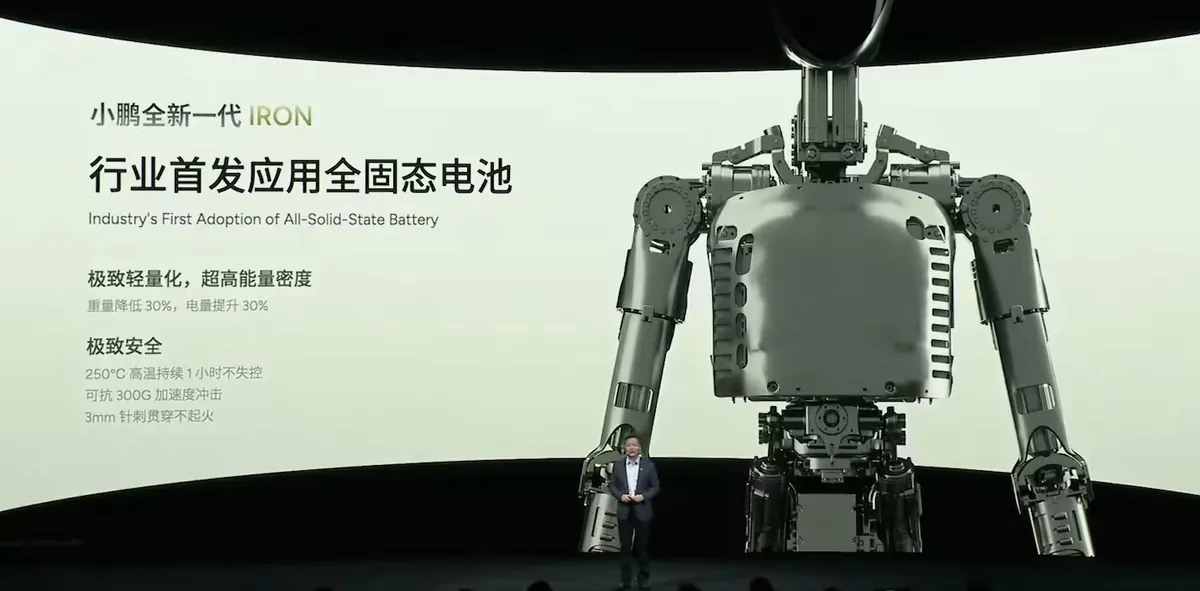
XPeng’s solid-state battery for its IRON humanoid robot is coming off the line in small batches, vice-president Gu Jie told the yearly congress of the China Society of Automotive Engineers on 28 October. IRON itself is still before the start of series production, which XPeng targets for the end of 2026, he said. His slide says “solid-state”; in November 2025 XPeng said IRON would be the first in the industry to use an all-solid-state battery.
Gu Jie and his slide
Gu Jie is now a key figure in XPeng’s robotics team. He leads systems engineering in its robotics centre, which He Xiaopeng runs, and remains XPeng’s vice-president for the electric powertrain, the motors and drive units that move its cars. He is one of the key managers XPulse lists for XPeng. On 28 October he spoke at SAECCE, the yearly congress and exhibition of the China Society of Automotive Engineers, held for the 33rd time.
His slide, headed “Physical AI: Energy”, says XPeng has introduced a solid-state battery made for robots. A robot has little room and every kilogram counts, so the slide gives the battery 30% more energy per kilogram. Robots work beside people in varied conditions, so XPeng says it rebuilt the safety standard: a design that stops heat spreading from a failing cell, and tests for impact, a nail driven through and a hot oven.

These are the kinds of test XPeng put figures on when it announced IRON’s battery last November: no fire with a 3 mm nail driven through, a jolt of 300 times the force of gravity, and an hour at 250°C without overheating out of control. It also said then that the battery was 30% lighter and held 30% more charge.
All-solid-state or semi-solid
An all-solid-state battery has no liquid inside; a semi-solid one keeps some. Gu Jie’s slide says solid-state, and its drawing labels a solid electrolyte; neither says whether any liquid remains. In September Jipian Lab, a Chinese publication covering the battery industry, reported that XPeng had chosen semi-solid cells for the production IRON. It said the main supplier is a smaller Chinese battery maker, after XPeng had sought all-solid-state cells from BYD, Gotion, CALB and EVE without success. XPeng has not confirmed the report, and has not said who makes the cells or how many have been made.
Where IRON stands
After trial production from July, XPeng opened IRON’s production line on 8 September, when the first robot walked off it after automated final assembly. On 23 September, after its first robot supplier conference, it said it had signed agreements with its parts suppliers and was scheduling production. It plans mass production at the end of 2026, a little over two months away, and deliveries from the first half of 2027, starting in its own stores and campuses.
Next: AI Day in November
He Xiaopeng said on 15 October that XPeng’s annual AI Day will be in Guangzhou in November. Last year’s was on 5 November, a date he named on Weibo on 30 October, six days ahead. There the new IRON first walked on stage; it moved so like a person that some viewers asked whether someone was inside, and the next day he posted a video showing the machinery under its covering. XPeng’s shares rose nearly 10% in New York that day and 2% in Hong Kong. By 11 November both listings were more than 20% above their closes before the show, a rise China EV Home tied to XPeng’s run of product and technology announcements.
This year’s AI Day is the next chance for XPeng to say more about IRON’s battery: whether it is all-solid-state or semi-solid, whether it matches last year’s figures for weight and charge, and how long the robot runs on a charge.
Topics
Where this comes from
- PrimaryXPeng shares its physical AI results: VLA 2.0, Robotaxi, the new IRON and the flying carCN · XPeng · 17 Nov 2025
- PrimaryWrapping up my Paris trip today … See you in Guangzhou in November for our annual AI Day.He Xiaopeng, on X · 15 Oct 2026
- MediaXPeng launches a solid-state battery made for robotsCN · Sina Auto (新浪汽车), on Weibo · 28 Oct 2026
- MediaXPeng robot solid-state batteries enter small-batch productionCN · First Financial (第一财经) · 28 Oct 2026
- MediaXPeng Begins Small-Batch Production of Solid-State Batteries for IRON RobotChina EV Home · 28 Oct 2026
- MediaExclusive: XPeng’s robot will go into production with semi-solid batteriesCN · Jipian Lab (极片Lab), on Tencent News · 4 Sep 2026
- MediaXpeng Surges Over 18% in Hong Kong, Market Cap Tops GeelyChina EV Home · 11 Nov 2025