China Pulse · Milestone
XPeng’s Robotaxi cleared to run a passenger service across Guangzhou
Confirmed
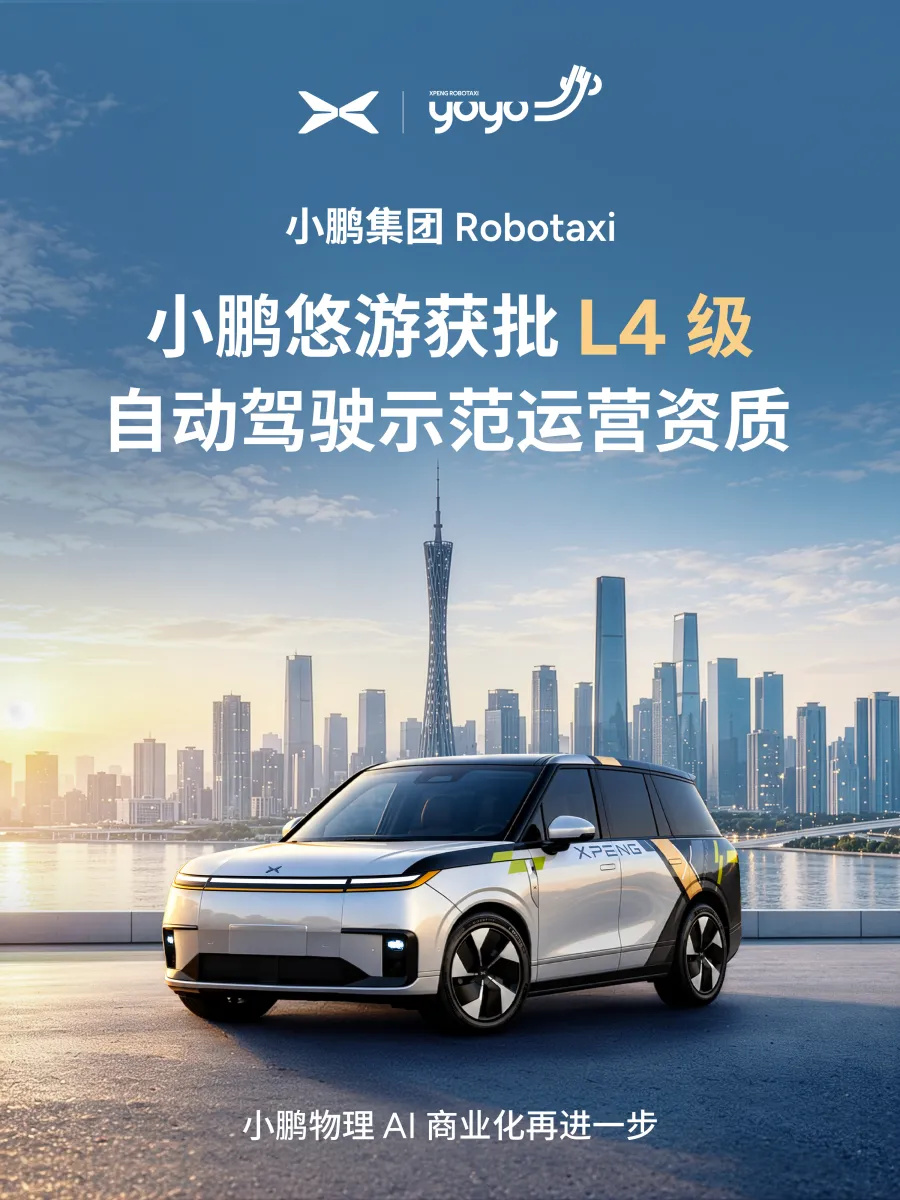
Guangzhou has approved XPeng’s Robotaxi, XPENG YOYO, for demonstration operations: under the city’s rules, a passenger service run as a business, valid in every district. XPeng announced the permit on 26 October, 18 days after opening rides to invited users. Rides stay by invitation for now, and the service area will widen step by step. XPeng’s goal for 2027 is passenger service with no safety operator on board.
What Guangzhou has approved
On 26 October, XPeng said its Robotaxi, XPENG YOYO, had been formally approved for demonstration operations at Level 4, the level at which the car drives itself, with no one needed at the wheel. Candice Yuan, who heads the Robotaxi business, wrote that Guangzhou’s qualification lets XPeng run them across the city (广州全域).
Under Guangzhou’s rules, demonstration operations are the step at which a self-driving service becomes a business. Cars that testing has shown fit to carry passengers do so on the city’s designated roads, and the operator may charge fares once it holds the transport department’s operating certificate. Only commercial operation comes after it.
The permit holds in every district, on the roads the city has opened to self-driving cars: 1,375 roads, about 2,662 kilometres, at the end of September. It lasts up to three years. Every car still needs a safety operator, on board or, where safety is assured, working remotely.
The step after the invited rides
The permit is the latest in a run of steps in XPeng’s home city. A road-test permit in January started routine testing on public roads. On 27 August, XPeng said its Robotaxi had a Guangzhou permit for remote testing: road tests with no safety operator in the driver’s seat, on the city’s designated Level 1, 2 and 3 test roads. On 8 October, it opened rides to invited users outside the company and called demonstration operations “the next stage”. Eighteen days later, that stage has its permit.
| Subject | 26 October | 8 October |
|---|---|---|
| Stage | Demonstration operations | Invited rides, before that stage |
| Area | Permitted in every district | One zone in Tianhe, in the app |
| Fares | Allowed; none announced | RMB1 a ride in the staff test |
| Next step named | No safety operator, in 2027 | Demonstration operations |
8 October: as recorded in XPulse’s article that day.
For riders, little changes at once. In the first phase, Candice Yuan wrote, the team will keep handing out invitation codes and widen the service area step by step. XPeng has not yet disclosed the size of the fleet or a fare. CNA, Singapore’s broadcaster, put the Guangzhou pilot at close to 100 cars on 9 October.
The permit also completes what XPeng planned for this year. Its Robotaxi page lists two items for 2026 in Guangzhou: this qualification and staff ride testing, which began in the summer. On 28 May, one XPeng release put demonstration operations in the third quarter and its results release in the second half of 2026. The permit came 26 days after the third quarter ended. Each date is on the Management Tracker.
What it means for the business
XPeng does not plan to run robotaxi fleets itself. It wants to sell the cars, the system and services to partners who do, and take a share of commissions. Running the service in Guangzhou, Candice Yuan wrote, will build the experience to supply “mature, replicable” Robotaxi solutions to partners around the world. On 13 October, He Xiaopeng said XPeng was in in-depth talks with several leading European ride-hailing platforms, and expected to make progress public soon.
Pony.ai and WeRide, both based in Guangzhou, are further along with the service: they already run paid rides there with no one in the car but the passengers. Where XPeng leads is the car, which it designs and builds itself, on its own line in Guangzhou.
XPulse’s reading: a licensed passenger service in its home city gives XPeng a working example that partners can inspect and ride in. XPeng has reported no Robotaxi revenue yet. The next tests are a first partner fleet and passenger rides with no safety operator on board, its goal for 2027.
- The Robotaxi opens to invited riders →
- Every Robotaxi step in Technology →
- XPeng’s Robotaxi targets, dated →
Topics
Where this comes from
- PrimaryXPeng's Robotaxi, XPENG YOYO, is formally approved for Level 4 autonomous-driving demonstration operationsCN · XPeng (official Weibo) · 26 Oct 2026
- PrimaryWe have been formally approved for Guangzhou's qualification for demonstration operations of intelligent connected vehicles, and can run Level 4 Robotaxi demonstration operations across the cityCN · Candice Yuan, head of Robotaxi (Weibo) · 26 Oct 2026
- PrimaryGuangzhou's rules for road tests and demonstration activities of intelligent connected vehicles and driverless equipmentCN · Guangzhou Transport Bureau and five city departments · 23 Sep 2025
- PrimaryGuangzhou Regulation on the Innovative Development of Intelligent Connected VehiclesCN · Guangzhou People's Congress · 20 Jan 2025
- PrimaryAn open Robotaxi technology platform (the roadmap: 2026, operation validated in Guangzhou)CN · XPeng (Robotaxi page) · 8 Oct 2026
- PrimaryHe Xiaopeng, the only Chinese carmaker CEO invited to speak at the Paris auto summit, presents XPENG AI ENGINEERINGCN · XPeng · 13 Oct 2026
- MediaChina’s Xpeng targets overseas robotaxi trials next year, wider rollout in 2 to 3 yearsCNA · 9 Oct 2026
- MediaGuangzhou explores the commercial development of autonomous drivingCN · Guangming Daily (陈慧娟, 吴春燕) · 13 Oct 2026