China Pulse · Milestone
XPeng’s Robotaxi, now XPENG YOYO, opens to invited riders
Confirmed
XPeng’s Robotaxi opened to riders outside the company on 8 October, eleven months after it was unveiled. Now named XPENG YOYO, it can be booked with an invitation code, after more than 2,200 rides by staff. XPeng calls it a move from testing to real users. Next come demonstration operations, the passenger service it plans to start in Guangzhou.
What opened on 8 October
XPeng gave its Robotaxi business a name on 8 October: 小鹏悠游 in Chinese, roughly “travel at leisure”, and XPENG YOYO abroad. The same day, it opened rides to people outside the company for the first time. They book through 小鹏YOYO自动驾驶, a ride-booking app that runs inside WeChat, and need an invitation code. XPeng also put a Robotaxi page on its website.
Staff had already taken more than 2,200 test rides, wrote Candice Yuan, who heads the business. XPeng says it will hand out more codes over time. In an earlier paid internal test, it charged RMB1 a ride to check payments and the service. It has not yet given a price for invited riders.
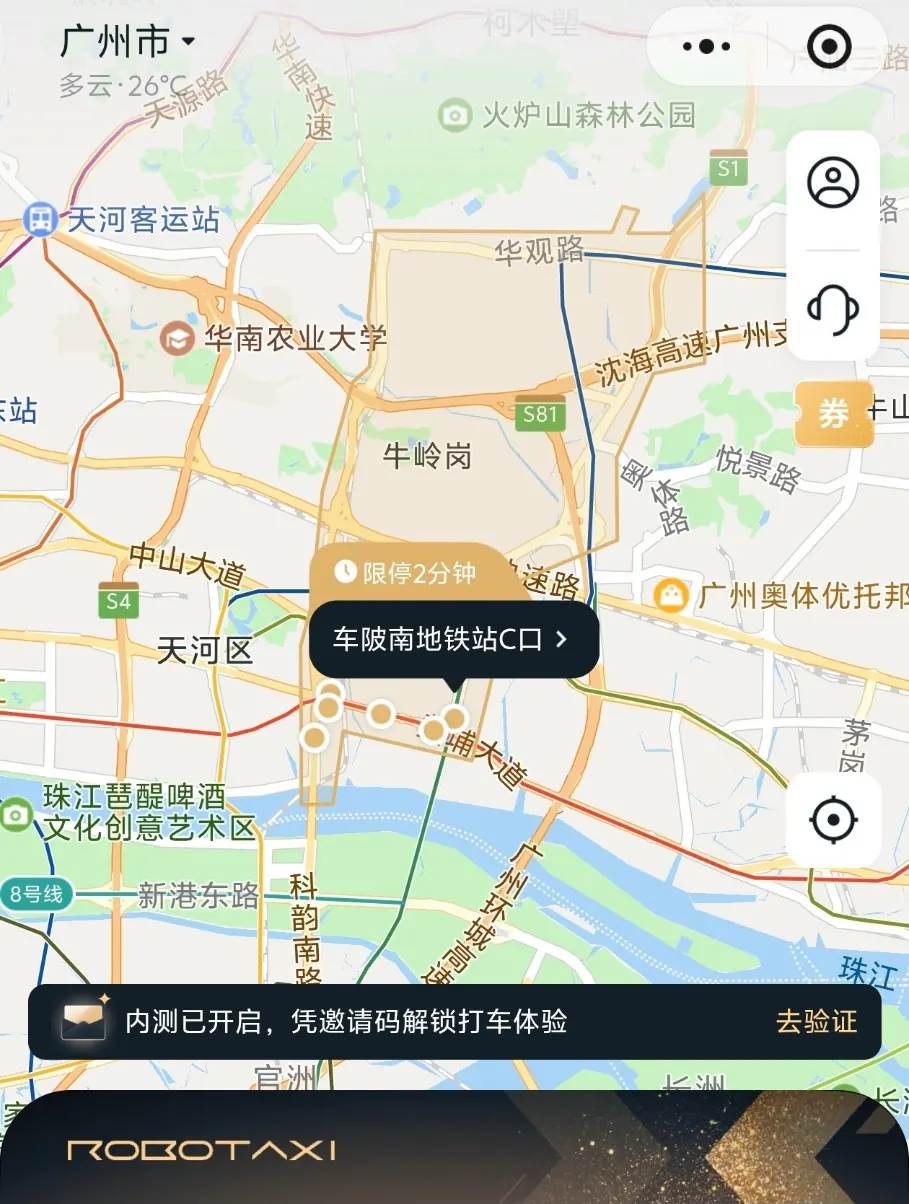
XPeng’s posts name no trial area and no fleet size. Its new Robotaxi page calls Guangzhou its model city (样板城市). The app itself shows one trial zone, in the city’s Tianhe district, in screenshots a Weibo user posted that morning.
He Xiaopeng called it “a new chapter for XPENG Robotaxi — moving from technology validation to real-world users and commercial exploration”. XPeng’s WeChat statement that morning says what comes next. The invited rides gather real users and operating experience for “the next stage, demonstration operations” (为下一阶段的示范运营积累真实用户和运营经验). Under Guangzhou’s rules, demonstration operations come after road testing and before full commercial service. XPeng has not said whether a safety operator rides along.
Eleven months from unveiling to outside riders
XPeng unveiled its Robotaxi at its Tech Day in November 2025. Candice Yuan dates the project’s start to that day. On 18 May the first mass-produced car came off XPeng’s own line in Guangzhou. XPeng calls it China’s first mass-produced Robotaxi developed entirely in-house.
| When | Step |
|---|---|
| 5 Nov 2025 | Unveiled at Tech Day; Amap named as the first partner |
| Jan 2026 | Routine L4 road tests begin on a Guangzhou permit |
| Mar 2026 | XPeng forms a Robotaxi business unit |
| 18 May 2026 | First mass-produced Robotaxi comes off the line in Guangzhou |
| Jun–Jul 2026 | Staff rides begin |
| Aug 2026 | Permit for road tests with no one in the driver’s seat, on designated roads |
| 8 Oct 2026 | Named XPENG YOYO; invited users outside XPeng can book |
From XPeng’s releases and posts, and Candice Yuan’s own timeline of 8 October. XPeng’s releases date the start of staff rides to June in one and to July in another.
XPeng has named two next steps. First come passenger demonstration operations. Then come passenger rides with no safety operator on board. It has not yet announced a permit for either.
Built in-house, from chip to car
The Robotaxi is a GX, XPeng’s flagship SUV, built on XPeng’s own line in Guangzhou. It carries four of XPeng’s own Turing AI chips, with 3,000 TOPS (trillion operations a second) of computing power. XPeng calls that the most in any car.
It drives with VLA 2.0, the AI model XPeng has been sending to its customers’ cars since March. It sees with cameras alone, without lidar or high-definition maps. XPeng says that lets it start quickly in a new city.
XPeng uses one set of technology for both. It covers the driver assistance in the cars it sells (L2) and driving with no driver at all (L4). XPeng calls this route “entirely different” from that of traditional L4 companies. The cabin is part of the pitch: massage seats, a rear entertainment screen, and the temperature and scent set in the app before pickup.
XPeng wants to sell the system, not run the taxis
In July, XPeng set out its business model. It “does not do operations” (不做运营). Its money would come from selling hardware, selling services and sharing commissions. Partners around the world would run the fleets. The 8 October statement repeats this.
The new Robotaxi page offers the car, the chips, the AI model and the manufacturing as an “open Robotaxi technology platform”. Partners can build their own services on it. At the unveiling, XPeng named Amap, Alibaba’s map app, as its first global partner.
In July, He Xiaopeng told The Wall Street Journal that XPeng was talking to dozens of potential partners. More than half were outside China, and he expected most of the business to be abroad. For now, bookings run through XPeng’s own app.
He also described the economics as he sees them. In Guangzhou, each car could cover its own costs in the second half of 2027 at the earliest. What decides it is how densely the cars cover an area, not the size of the fleet. In a smaller city, a few hundred cars could be enough. Brian Gu, XPeng’s president, told Reuters in April that XPeng would likely build hundreds to thousands of Robotaxis over the following 12 to 18 months.
XPulse’s reading: XPeng has reported no Robotaxi revenue yet. Under the model it describes, the money comes from partners: the cars and systems they buy, the services and the commissions. So the first partner fleet will say more about the business than rides booked in XPeng’s own app.
How XPeng compares in Guangzhou
Where XPeng leads its home-city rivals is the car. It builds its own, at a carmaker’s scale: it delivered 118,390 cars in the third quarter. Pony.ai and WeRide depend on carmakers for theirs.
The rivals are further along with the service itself. Both already run fully driverless, paid rides in Guangzhou. WeRide runs them around the clock in three districts, Tianhe among them. Each has 1,800 to 2,000 robotaxis worldwide. Baidu’s Apollo Go, another rival, counts 28 cities and more than 240 million kilometres driven fully driverless.
| Company | Robotaxis | Driverless paid rides in Guangzhou | Own cars |
|---|---|---|---|
| XPeng | Not given | Not yet; goal 2027 | Yes |
| Pony.ai | 1,975 | Since Nov 2025 | No |
| WeRide | 1,800+ | Yes, 24 hours | No |
Robotaxis worldwide. Pony.ai: at 30 June (second-quarter release), driverless paid rides in Guangzhou since November 2025 (annual report), cars made by GAC, BAIC and Toyota. WeRide: at 31 July, service round the clock (interim report), cars made by Geely’s Farizon. Apollo Go: Baidu’s second-quarter release.
XPulse’s reading: XPeng is not the first to run driverless rides in Guangzhou, and it is not trying to win as an operator. It wants to sell its system to the companies that run fleets. There, it has what Pony.ai and WeRide lack: a car it designs and builds itself, with its own chips and AI model. Candice Yuan frames the challenge the same way. For the industry, she wrote, carrying passengers by autonomous driving “is no longer anything new”. The hard part is making each ride good enough. XPeng also argues that needing no lidar or high-definition maps cuts the cost of each new city. It has not yet published a cost figure to show it.
What comes next
XPeng has set dates for each step since the unveiling. At Tech Day it said trial operation would start in 2026. It also said it would launch three Robotaxi models that year. In March, He Xiaopeng put passenger demonstration operations in the second half of 2026. On 28 May, one XPeng release narrowed that to the third quarter, in Guangzhou. Its results release the same day kept the second half of the year. In July, XPeng planned trial operation and “small-to-medium-scale routine demonstration operations” within 2026.
The 8 October statement puts demonstration operations after this step, so they did not start in the third quarter. The second-half deadline runs to 31 December. Of the three models promised for 2026, one is on the road so far, built on the GX. The new Robotaxi page lists a new-generation model for 2027. Passenger rides with no safety operator are the goal for 2027, as He Xiaopeng said in August. In March he had hoped for the start of 2027. Each statement, dated and sourced, is on the Management Tracker.
Three things would show how far the Robotaxi has come. How many cars run, and where? When do demonstration operations start, and on what permit? And when does a partner such as Amap start taking bookings? XPeng’s third-quarter results, expected in November, are the next scheduled update.
Where this comes from
- Primary 小鹏集团 Robotaxi 正式定名—— 小鹏悠游,XPENG YOYO · XPeng (official Weibo) · 2026-10-08 · ZH-CN
- Primary 今天,小鹏 Robotaxi 业务正式定名为「小鹏悠游」,海外名定为「XPENG YOYO」 · Candice Yuan, head of XPeng's Robotaxi business (Weibo) · 2026-10-08 · ZH-CN
- Primary 小鹏悠游 XPENG YOYO,来了 · He Xiaopeng (Weibo) · 2026-10-08 · ZH-CN
- Primary Meet XPENG YOYO, the official name of XPENG Group's Robotaxi brand · XPENG (X) · 2026-10-08
- Primary Today, XPENG Robotaxi gets a name of its own: XPENG YOYO — 小鹏悠游. · He Xiaopeng (X) · 2026-10-08
- Primary 开放的Robotaxi技术平台 · XPeng (Robotaxi page) · 2026-10-08 · ZH
- Media 小鹏Robotaxi正式定名“小鹏悠游”,打车小程序同步上线 · Sina Tech, carrying XPeng’s WeChat statement · 2026-10-08 · ZH
- Media XPENG names Robotaxi service ‘XPENG YOYO’ · Gasgoo · 2026-10-08
- Media 小鹏集团 Robotaxi 定名小鹏悠游 XPENG YOYO,打车小程序同步上线 · IT之家 · 2026-10-08 · ZH
- Community 还没大规模商用,先体验了小鹏 Robotaxi 的 AI 出行 (screenshots of the mini-program) · 春卷 (Weibo) · 2026-10-08 · ZH-CN
- Primary 《广州市智能网联汽车与无人驾驶装备道路测试及示范活动管理办法》的解读 · Guangzhou Municipal Transport Bureau · 2025-09-25 · ZH
- Primary 小鹏分享物理AI涌现成果:发布第二代VLA、Robotaxi、全新一代IRON和飞行汽车 · XPeng · 2025-11-05 · ZH
- Media 全文|小鹏Q4业绩会实录:会将车载大模型从数十亿级别提升到超过200亿的级别 · Sina Finance · 2026-03-20 · ZH
- Media 小鹏汽车首次实现季度盈利,何小鹏:完全自动驾驶有望在未来1至3年到来 · Red Star Capital, via cnfol · 2026-03-20 · ZH
- Primary 中国首台全栈自研Robotaxi量产下线!小鹏GX为原型车,本地算力3000 TOPS全球最高 · XPeng · 2026-05-18 · ZH
- Primary 小鹏集团发布2026年第一季度财报:毛利率维持20.6%高位,加速推动物理AI应用商业化 · XPeng · 2026-05-28 · ZH
- Primary 小鹏集团完成从智能电动车企到物理AI公司的蜕变:第二代VLA规模落地、Robotaxi量产下线、人形机器人年底量产同步推进 · XPeng · 2026-05-28 · ZH
- Primary 小鹏Robotaxi开启员工内测:从新能源汽车到“机器人汽车”,首次明确全球化商业路径 · XPeng · 2026-07-09 · ZH
- Media 何小鹏:目标到明年下半年,小鹏广州 Robotaxi 业务实现单车盈亏平衡 (citing The Wall Street Journal) · IT之家 · 2026-07-24 · ZH
- Media 何小鹏:目标在明年实现 Robotaxi 无安全员载客运营 · IT之家 · 2026-08-24 · ZH
- Primary 小鹏集团8月共交付新车39107台,实现同环比双增长 · XPeng · 2026-09-01 · ZH
- Primary 小鹏集团9月共交付新车41,256台 · XPeng · 2026-10-01 · ZH
- Media China’s Xpeng begins mass production of robotaxis in Guangzhou · Reuters via Yahoo Finance · 2026-05-18
- Primary PONY AI Inc. Reports Second Quarter 2026 Financial Results (Form 6-K exhibit 99.1) · Pony AI Inc. (SEC) · 2026-08-18
- Primary Annual report on Form 20-F for 2025 · Pony AI Inc. (SEC) · 2026-04-22
- Primary 2026 Interim Report (Form 6-K exhibit 99.1) · WeRide Inc. (SEC) · 2026-09-14
- Primary WeRide and Geely Farizon to Deliver 2,000 Purpose-Built Robotaxi GXRs by 2026 · WeRide · 2026-03-09
- Primary Baidu Announces Second Quarter 2026 Results (Form 6-K exhibit 99.1) · Baidu, Inc. (SEC) · 2026-08-18